
The Picture of Dorian Gray
Title, Genre and Setting
Step inside the hidden rooms of Oscar Wilde's London. This page is your roadmap to the key building blocks of The Picture of Dorian Gray: the title, genre, and setting.
Instead of just memorising facts, you'll join ANNA and ANNE in a deep dive through our interactive lesson. Use the video guide to build your own mind map, master sophisticated exam phrases that will impress any examiner and explore a curated word list designed to stop "frozen brain"moments during speaking tasks.
Mind Maps
Title, Genre, and Setting
The following mind maps help learners visually connect key story elements so they can better understand how a text works. By breaking down the title, genre and setting into clear branches and sub ideas, students can see patterns, make predictions and organise their thinking. The colourful diagrams support different learning styles, encourage discussion and provide a quick reference that makes complex concepts easier to understand, remember and apply when analysing literary works.
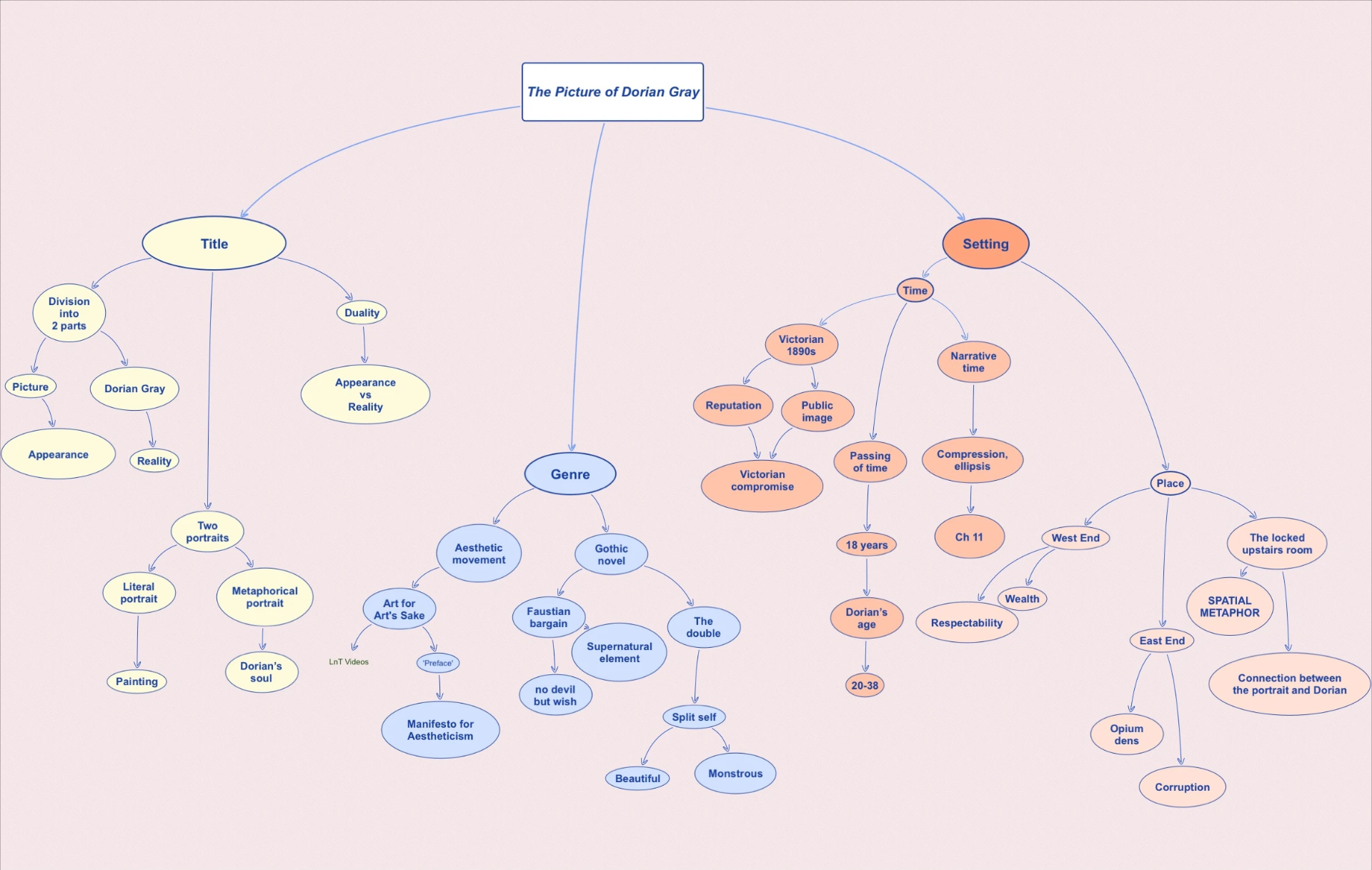
Comprehensive colour-coded mind map of "The Picture of Dorian Gray"'s Literary Elements.
It features three main branches:
Title: exploring duality and two portraits;
Genre: covering Aestheticism and Gothic elements;
Setting: detailing the Victorian age and the contrast between the West End and East End. Okay, simplified.
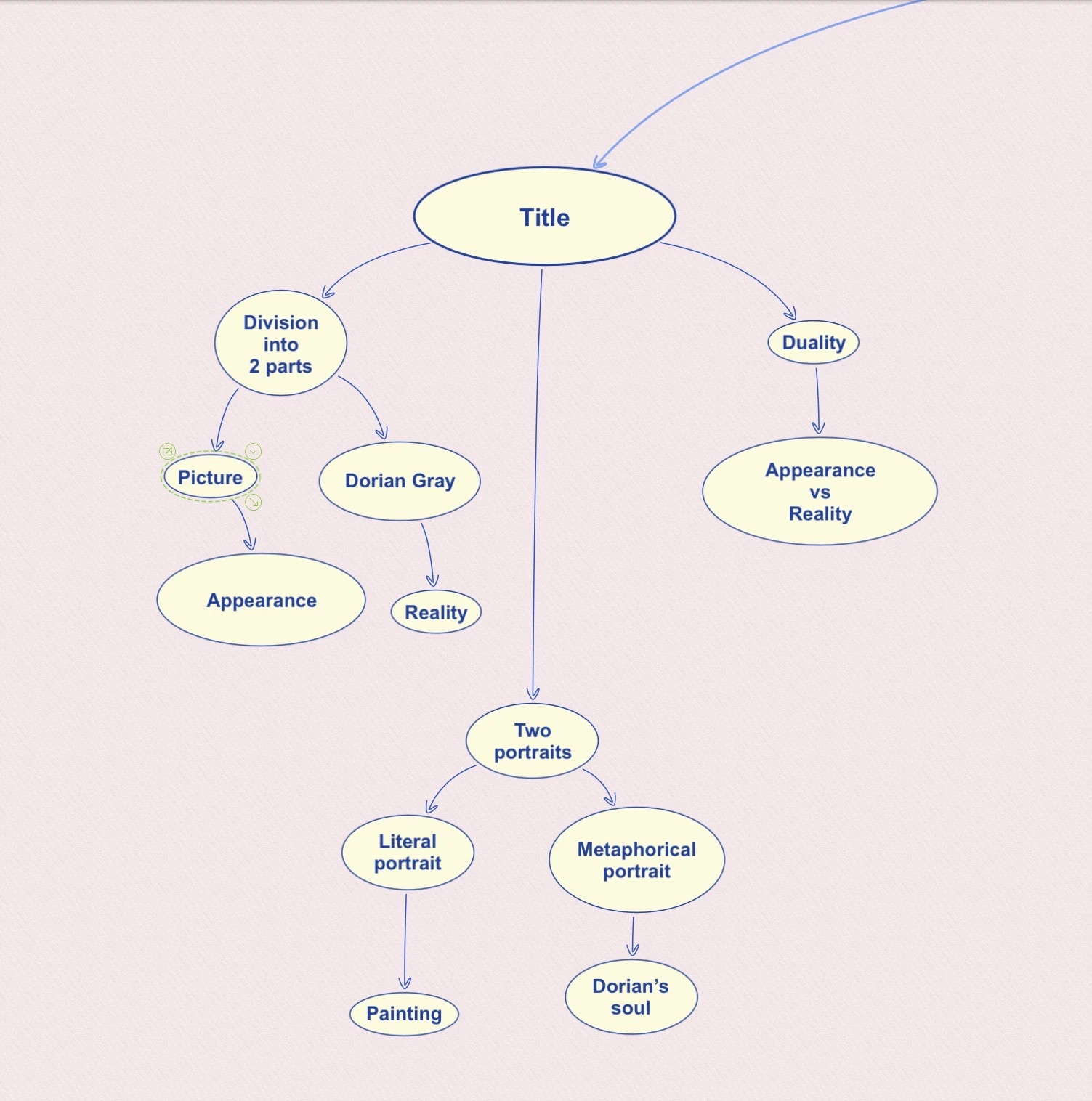
Detailed mind map of "The Picture of Dorian Gray"'s Title.
An enlarged, focused view of the Title branch of the mind map. It breaks down the title of the book into its conflict "Appearance vs Reality". Sub-nodes further define the "Two portraits"as the "literal portrait"and the"metaphorical portrait".
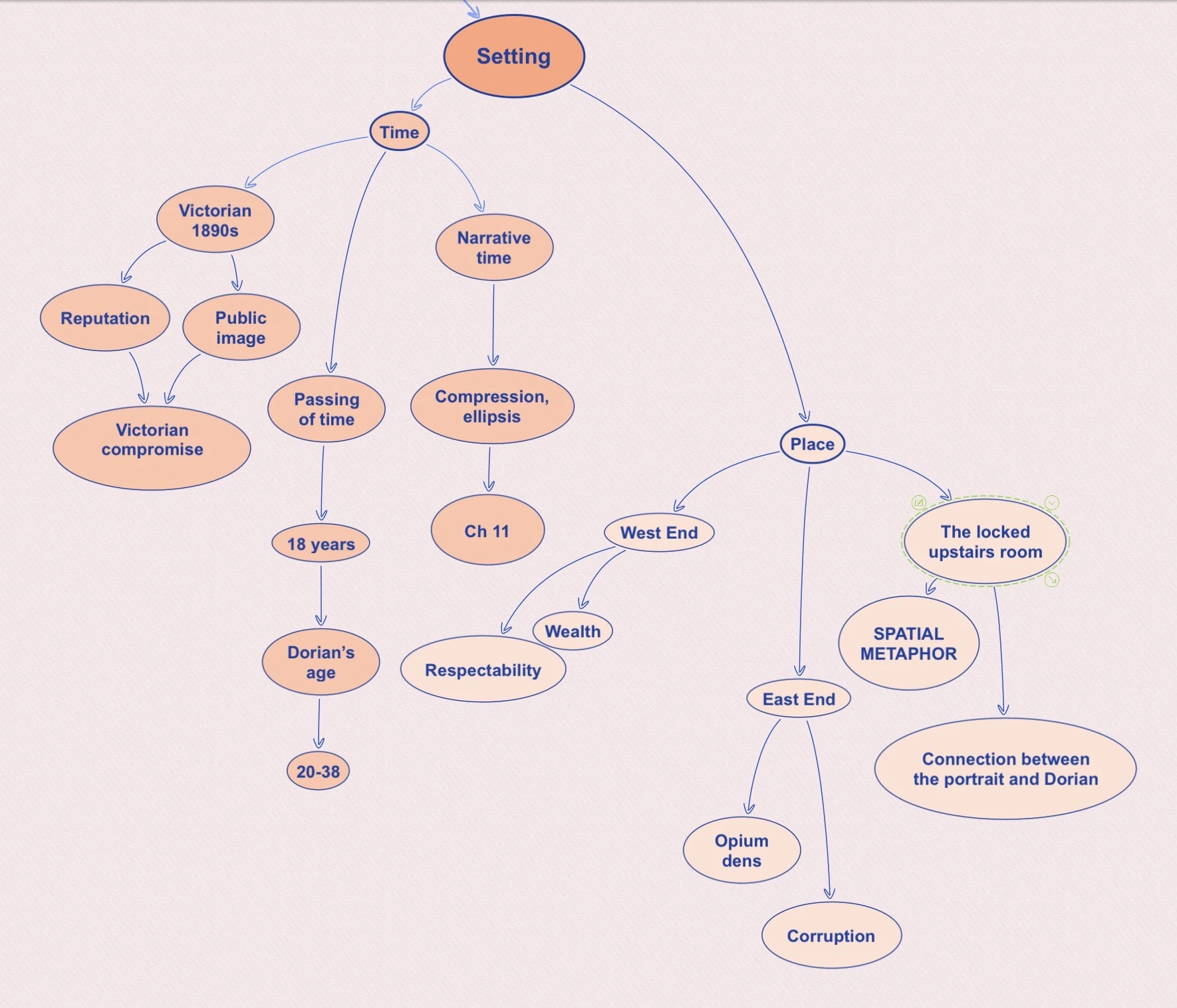
Detailed mind map of "The Picture of Dorian Gray"'s Setting
A detailed close-up of the Setting section of the mind map. The Time branch covers the Victorian 1890s, the Victorian compromise and the passage of time. The Place branch contrasts the west end with the east end linked by a special metaphor.
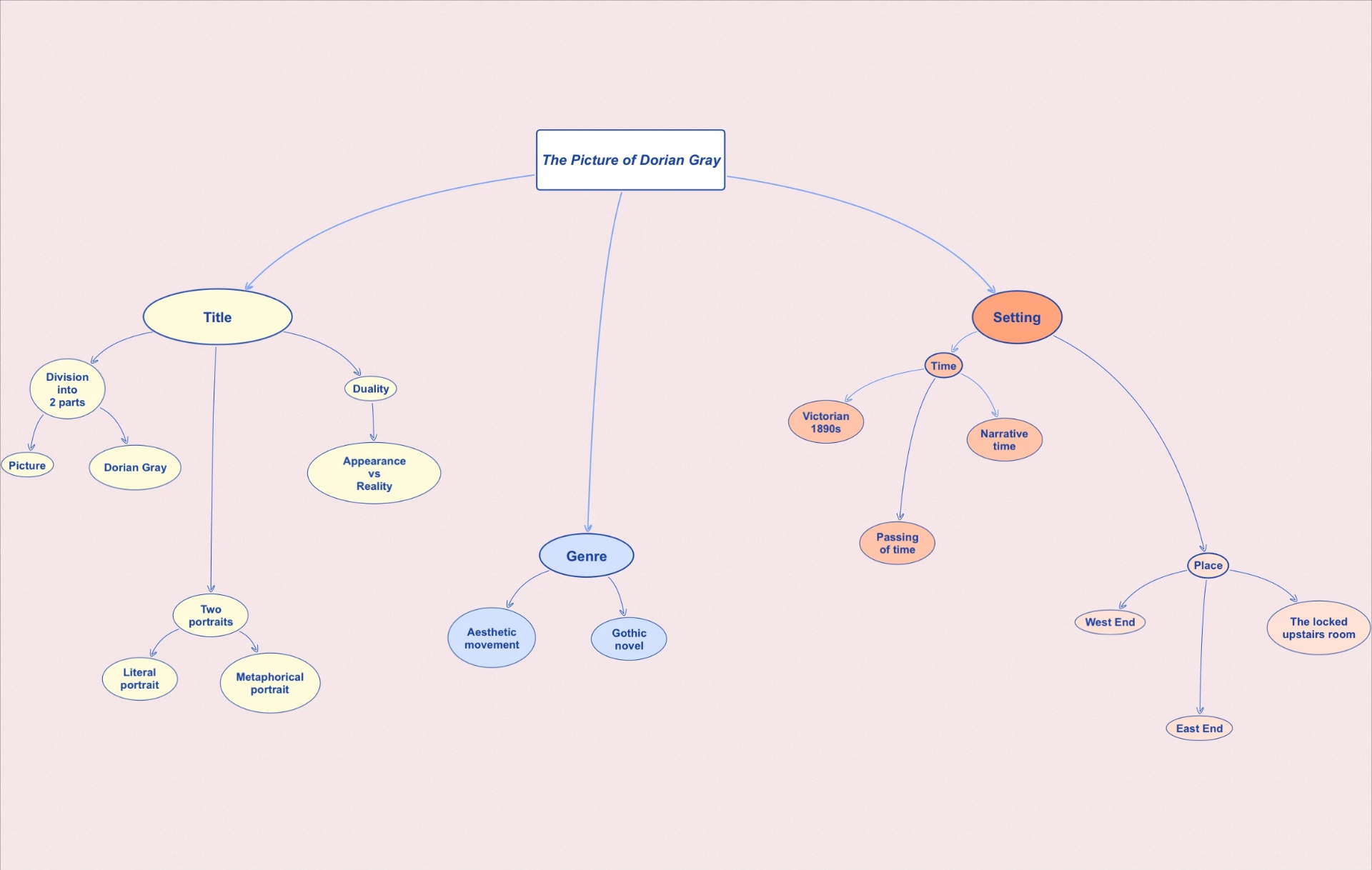
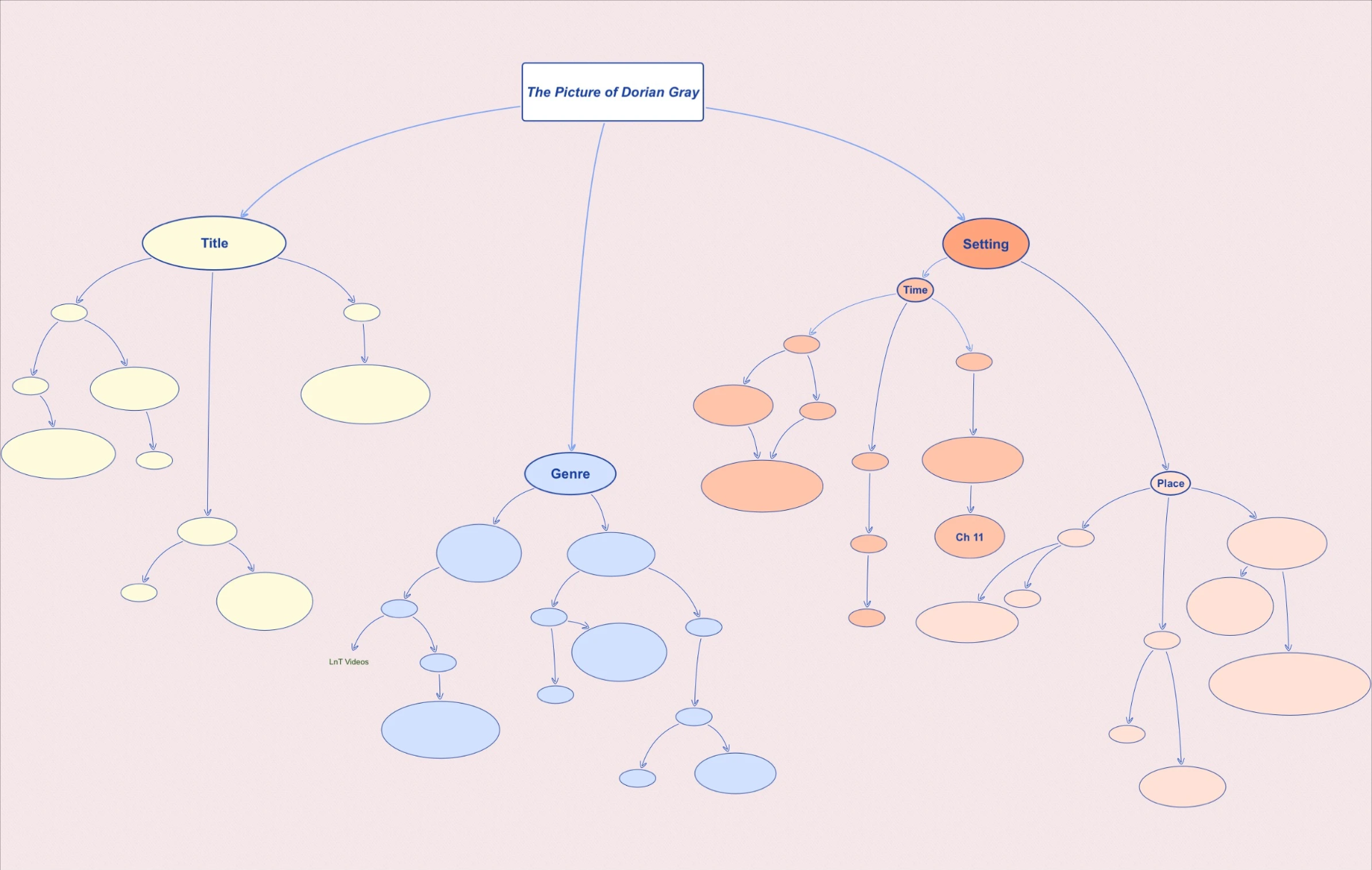
A simplified colour-coded version of the mind map for the analysis of literary elements. It retains the core branches: title, genre and setting but removes many of the smaller, specific sub details. This version provides a high-level overview of the major literary categories. You can use it for your first attempt to illustrate the map orally.
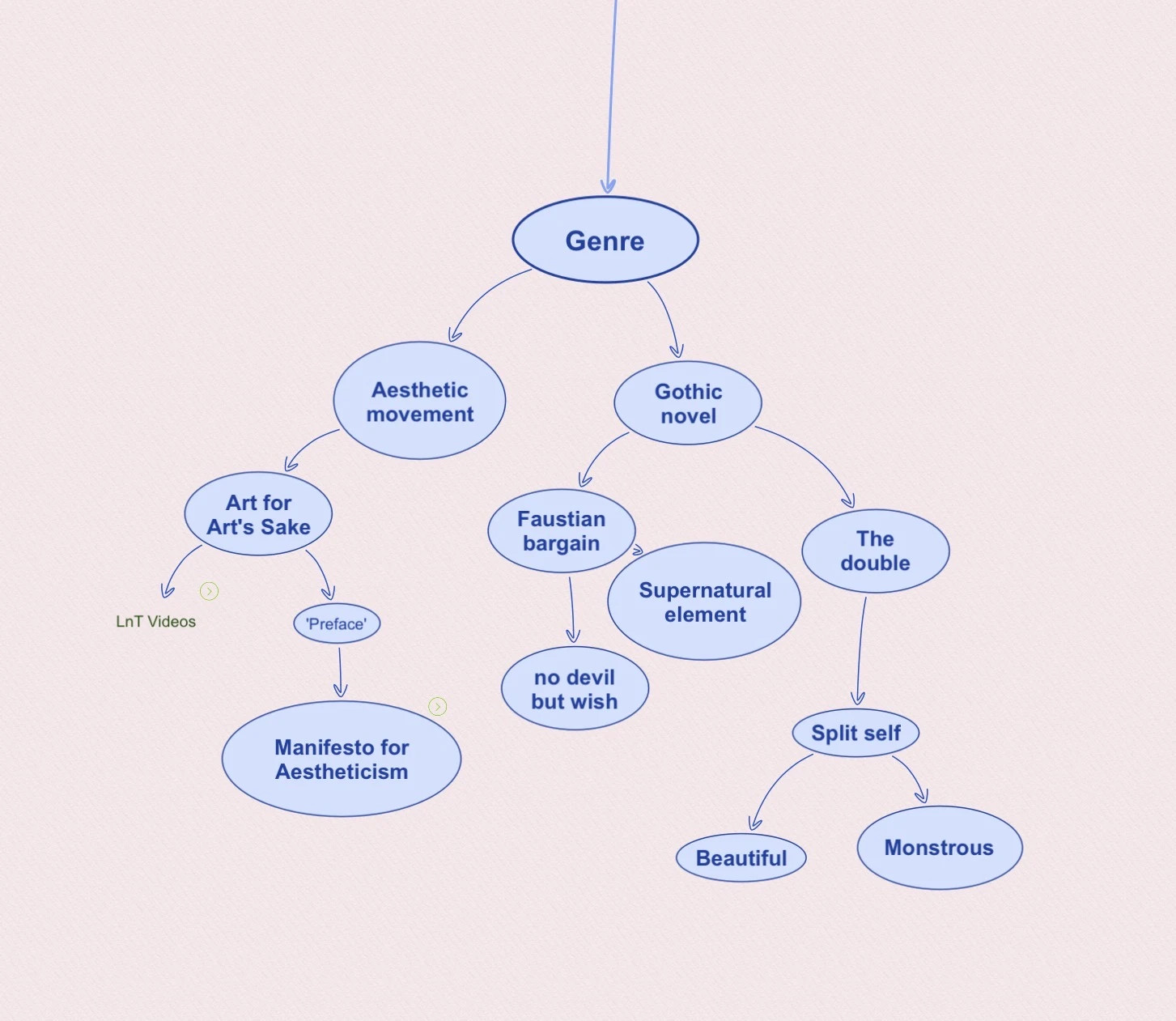
Detailed mind map of "The Picture of Dorian Gray"'s Genre.
A detailed the close-up of the Genre section of the mind map. It branches into two primary categories: Aesthetic movement and Gothic novel.
A blank, colour-coded mind map titled "The Picture of Dorian Gray". Three main branches extend from the centre: a yellow Title branch on the left, a blue Genre branch in the middle and an orange Setting branch on the right. Most sub- bubbles are empty, except for small labels, providing a template for student students to fill in their own notes.
Word List
INTERACTIVE WORD LIST |
||
Words |
Meanings |
Traslations |
| Intertwined: (Adjective) | When two things are twisted together or closely connected. Context: Dorian’s physical appearance and his moral reality become intertwined. | |
| Surface-level: (Adjective) | Only what is on the outside; not deep or serious. Context: The "picture" is just the surface-level image he shows to society. | |
| Literal vs. Metaphorical: (Adjectives) | "Literal" is the actual object (the painting); "Metaphorical" is the symbolic meaning (his soul). | |
| Duality: (Noun) | The state of having two different or opposite parts. Context: The main theme of the book is the duality between beauty and ugliness. | |
| Fusion: (Noun) | A mix or blend of different things. Context: The novel is a fusion of Aestheticism and Gothic traditions. | |
| Manifesto: (Noun) | A public statement explaining the intentions or motives of an artistic movement. Context: The "Preface" acts as a manifesto for Aestheticism. | |
| Bargain: (Noun) | An agreement or deal (often where both sides give something up). Context: Dorian makes a Faustian bargain: his soul for eternal youth. | |
| Compression & Ellipsis: (Nouns) | Literary tools used to shorten time. Compression squeezes time together; Ellipsis skips it entirely. | |
Useful Expressions |
||
|
"As the story progresses..."
Literary Use: To describe development or a change in status. Example: "As the story progresses, these two parts, appearance and reality, become intertwined." Everyday English: Use this to describe how a situation develops during the day or an event. Everyday Example: "As the day progresses, the rain gets heavier." "It shifts into..." Literary Use: To explain a transition between different genres, moods, or narrative styles. Literary Example: "The novel shifts into Gothic fiction with supernatural events, locked rooms, and feelings of terror." Everyday English: Use this to describe a sudden change in the "vibe" or type of activity. Everyday Example: "The film starts as a love story, but then shifts into a thriller." "Functions as a spatial metaphor..." Literary Use: To explain how a physical location (a room, a city, a house) represents a psychological state or an abstract idea. Literary Example: "The locked room functions as a spatial metaphor for Dorian's repressed guilt." Everyday English: Use this to describe how your physical environment reflects your current mood or mental state. Everyday Example: "My messy desk functions as a sign of how stressed I am." |
||
Grammar | ||
|
State Verbs:
In the script, Anne says: "Dorian remains physically frozen." B1-B2 learners often try to put these verbs into the "ing" form (e.g., "Dorian is remaining frozen"), which is a mistake. Rule: Verbs that describe a state or condition, not an action, usually stay in the Present Simple. Represents: "The picture represents appearance." (Not: is representing) Consists of: "The setting consists of two parts: time and place." Seems: "The title seems simple." |
||
Bibliography
Dryden, Linda. The Modern Gothic and Literary Doubles: Stevenson, Wilde and Wells. Palgrave Macmillan, 2003.
Ellmann, Richard. Oscar Wilde. Alfred A. Knopf, 1988.
Ledger, Sally, and Roger Luckhurst, editors. The Fin de Siècle: A Reader in Cultural History, c. 1880–1900. Oxford University Press, 2000.
Mighall, Robert. A Geography of Victorian Gothic Fiction: Mapping History's Nightmares. Oxford University Press, 1999.
Wilde, Oscar. The Picture of Dorian Gray. Edited by Robert Mighall, Penguin Classics, 2003.