
The Strange Case of Dr Jekyll and Mr Hyde
A Presentation of the novel in 8 Literary Elements
Learn how to organise the plot of this novella and access our free resources: video, blank mind map, useful phrases.
Access our partial video analysis (title, setting, themes) and the Jekyll and Hyde Analysis Guide: video, blank mind map, useful phrases.
Access the playlist: Strange Case of Dr Jekyll and Mr Hyde | English Literature Analysis
COMPLETE ANALYSIS
"The Strange Case of Dr. Jekyll and Mr. Hyde" is both a Gothic and classic detective novel. It explores the complexities of human nature together with the dangers of repressing or indulging our darker sides.
Explanation of the Complete Title:
The title "The Strange Case of Dr. Jekyll and Mr. Hyde" contains an obvious reference to the two central characters of the novel, Dr. Jekyll and Mr. Hyde. The two characters represent the good and evil sides of humanity respectively. Through an investigation, the readers understand Jekyll and Hyde are the same person, representing both sides of human nature.
The second part of the title: "The Strange Case of" is a phrase that suggests that the story will involve a legal, medical or police case. It is certainly an effective way to strike the readers's attention ("Strange") to the story by hinting at mysterious events ("Case") that will unfold later. The adjective 'strange' lead the readers to decide the third hypothesis: a police case.
"Dr. Jekyll" is the name of the protagonist of the story, Henry Jekyll, a respected and well-known physician. The surname Jekyll is derived from the Breton name 'Judicaël'. The name is traditionally pronounced 'jeekəl', but 'jeckəl' is also common. It means "generous lord". This name fits perfectly to a physician who is supposed to help others but also raises a question: what lies beneath his seemingly benevolent exterior?
"Mr. Hyde" is the other name in the title. "Hyde" comes from Old English hȳdan : to hide, conceal, indicating that this personality is hidden and cannot be easily seen or understood.
This title highlights the duality of the two central characters, the strange events that occur throughout the story and creates a sense of mystery and intrigue at the same time.
Genre:
The book, "The Strange Case of Dr. Jekyll and Mr. Hyde," is a unique story that combines two different genres, a Gothic novel and a detective story. Throughout the book, you can see the Gothic elements, such as terror and darkness, mysterious and isolated settings.
These aspects belong to the common characteristics of Gothic novels. In addition, they help highlighting the dual nature of the society depicted in the novel. The opposing values of Victorian society* are reflected in Dr. Jekyll's personality and behaviour.
Thanks to the character of Mr. Utterson, who, although a lawyer by profession, acts as an investigator through the story, an intriguing element is added making the story similar to "The Strange Case of Dr. Jekyll and Mr. Hyde" that of a classic detective story. Utterson provides clues to uncover the mystery of Mr. Hyde and the strange events surrounding Dr. Jekyll. Even though he does not disclose the solution to the mystery, his involvement as an investigator significantly contributes to the building of suspense in the story. In the end, the truth is revealed by Dr. Jekyll in a shocking final statement.
*Victorian society was characterized by opposing values that often conflicted with each other. One of these was the tension between morality and the repression of human desires. People were expected to respect strict moral codes and repress any desires that went against them, especially the upper class.
Plot:
To better understand this novella, we have to understand the plot is told through the contribution of several narrators.
Novel and its narrators:
• "The Strange Case of Dr. Jekyll and Mr. Hyde" is a novella set in late 19th-century
London.
• It follows the story of respected physician and scientist Dr. Henry Jekyll, who
creates a potion that allows him to separate his good and evil personalities.
• This results in the appearance of the cruel and animalistic Mr. Hyde, who puts
Jekyll's reputation and life in danger.
• The novella is told through the perspectives of multiple narrators, each providing a unique viewpoint on the events that take place.
• The main narrator is Mr. Utterson, a lawyer and close friend of Dr. Jekyll.
• Other narrators include Mr. Enfield, the maid of Dr. Jekyll's house, Dr. Lanyon, and Dr. Jekyll himself.
The life of Dr. Henry Jekyll, a well-respected physician and scientist is uncovered, clue after clue, in this novella. His research leads him to the creation of a potion that separates his good and evil personalities. The cruel and animalistic Mr. Hyde appears all of a sudden. Mr. Hyde puts Jekyll's reputation and life in danger.

Multiple narrators contribute to narrate the story, each offers a unique perspective on the events that take place. Mr. Utterson, Dr. Jekyll's lawyer and close friend, is the main narrator. As Hyde inherits all of Jekyll's property in the event of his disappearance or death, Utterson starts investigating the strange relationship between Jekyll and the mysterious Mr. Hyde. He encounters a number of other characters who provide their ownaccounts of the events.
The maid of Dr. Jekyll's house recounts a visit by Mr. Hyde, which left her deeply disturbed by his evil appearance. Another narrator is Dr. Lanyon, a former friend of Jekyll's. In a letter to Utterson, Lanyon describes when Jekyll asked him to retrieve a potion that would turn Mr. Hyde into him.
The final narrator is Dr. Jekyll himself. In a statement he reveals the true nature of his relationship with Hyde and the consequences of his experiments and his intention to get rid of Mr Hyde.
Characters:
The main characters of the novel are Dr. Henry Jekyll, Mr. Edward Hyde, and Mr. Utterson.
Dr. Jekyll is a respected physician and scientist who creates a potion to separate the good and evil aspects of his personality. Mr. Hyde is the cruel and animalistic alter-ego that appears after Dr. Jekyll drinks the potion. The very name Mr Hyde (to hide) adds mystery to the novella. As a consequence of the name, the character will be very often concealed or isolated from society. The readers may also think Mr Hyde has to hide because of his beast-like tendencies. Mr. Utterson is Dr. Jekyll's lawyer and acts as a detective trying to uncover the mystery of Dr. Jekyll's behaviour. He is focused on when/what to say and on keeping silent on purpose. He is described as cold but never judgmental. Mr Utterson represents the values of the Victorian age. He is known for his strong desire to uphold justice and morality. Utterson is also a person who inspires trust due to his honest and reliable nature. In the novel, he serves as the credible voice of reason who speaks out against the immoral behaviour of Dr. Jekyll and Mr. Hyde.
Settings:
The setting in the story of "Dr. Jekyll and Mr. Hyde" reflects the characters' duality. Jekyll's town house, located in Leicester Square, London, symbolises his desire for respectability while its adjoining laboratory represents his hidden identity as Mr. Hyde.

The contrast between the house, which is described as wealthy and comfortable, and the laboratory, which is described as a dissecting room in a hospital, highlights Jekyll's inner conflict between good and evil. The house's location in a wealthy area of London but close to poorer areas hints at the duality in Victorian society. The living room is described as the "pleasantest room" in London while the laboratory is where "evil deeds were done", further emphasising the dual theme. Most scenes take place at night, especially when Mr Hyde is involved.
Point of View:
The story is narrated from the point of view of Mr. Utterson, who is a third-person limited narrator. The story also includes two chapters narrated by Dr. Lanyon and Dr. Jekyll through letters, (confessions) which give the readers more information about them. Mr. Utterson can read the thoughts and feelings of other characters. The story moves forward when Mr Utterson speaks with other characters.
The book also includes four other stories told by Mr. Enfield, the maid, Dr. Lanyon, and Dr. Jekyll, which reveal something more about the characters and their feelings:
- Mr. Enfield tells Utterson a story about a door.
- The maid tells Utterson about what she saw when Mr. Hyde visited Dr. Jekyll's house.
- Dr. Lanyon writes a letter to Utterson about Mr. Hyde.
- Dr. Jekyll (first person narrator in this case) writes a statement which is the last chapter of the novella. These stories help the readers better understand the characters and what is happening in the story.
The narrative style is a mix of direct dialogue, events descriptions, and Utterson's own thoughts. Stevenson uses this method to create an atmosphere of tension and mystery as Utterson attempts to find the truth about the relationship between Jekyll and Hyde.
Importance of narrators:
• The use of multiple narrators allows readers to piece together the full story of Jekyll
and Hyde's relationship and the ultimate fate of the characters.
• The three first-person narrators help readers tie a connection with the characters and their thoughts or emotions.
• Dr. Lanyon has limited knowledge of the facts and sees the transformation of Mr. Hyde into Dr. Jekyll.
• Dr. Jekyll's statement in the last chapter is a confession that ignores what the other characters have accomplished, and he leaves all his properties to Mr. Hyde.
Narrative Techniques
Stevenson combines direct dialogue, descriptions of events, and Utterson's own thoughts to create an atmosphere of tension and mystery. His choice is to let his readers see the story through the eyes of Mr. Utterson. By doing this, the readers can only discover the truth through Mr. Utterson's version.
Stevenson uses two important narrative techniques: foreshadowing and flashbacks. We can find an example of foreshadowing early in the book (chapter one): Mr. Utterson and Mr. Enfield are out for a walk and pass by a certain door. Mr. Enfield describes a strange man who ran over a young girl and then vanished through the door. We learn later in the story that the man was Mr. Hyde and that the door led to Dr. Jekyll's laboratory. The door's early mention, as well as the strange events surrounding it, presage Jekyll and Hyde's relationship. This creates a sense of anticipation and excitement.
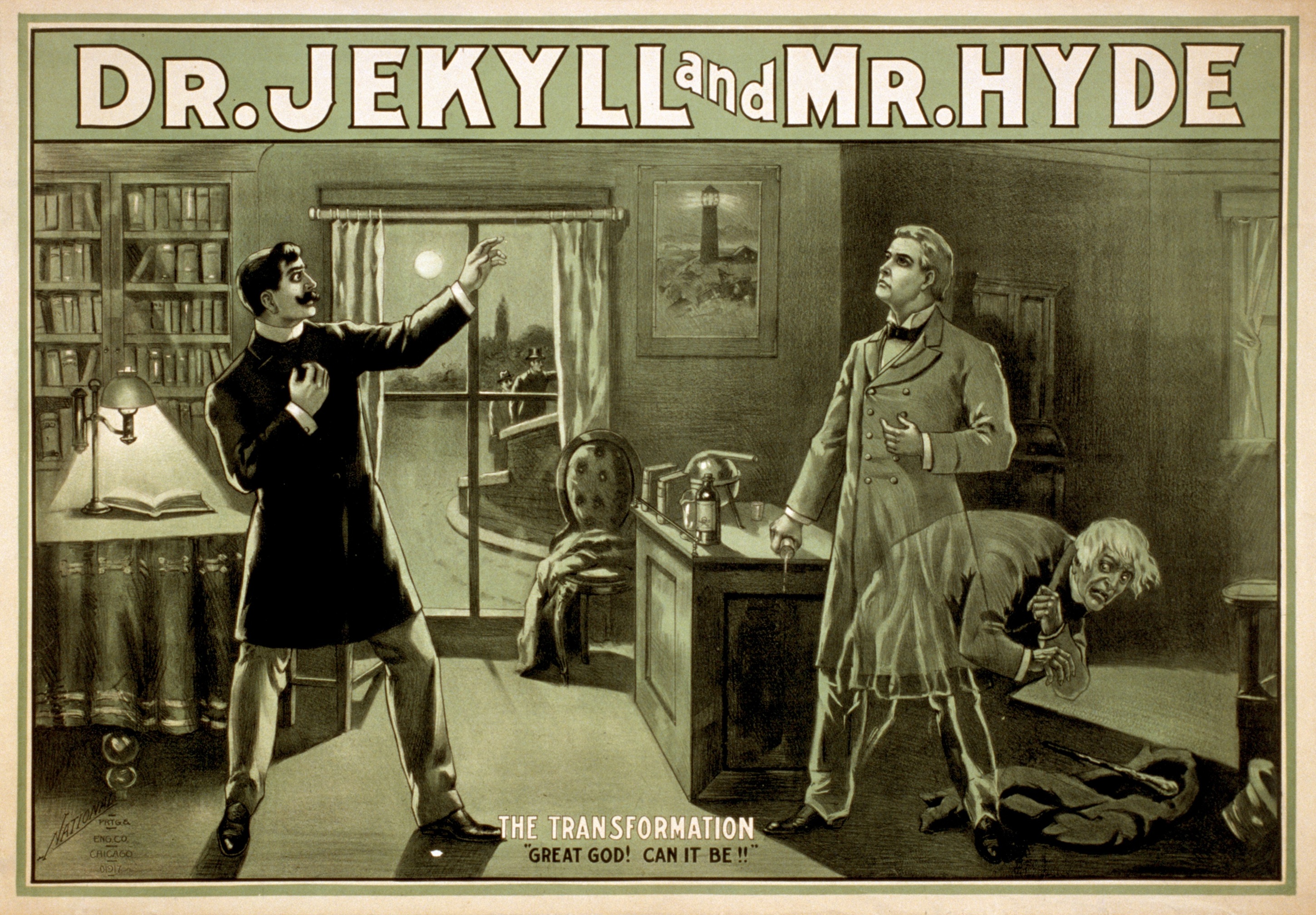
The scene where Dr. Lanyon describes seeing Mr. Hyde transform back into Dr. Jekyll is an example of a flashback (chapter 9). Flashbacks tell the readers about Dr. Jekyll's past and add complexity and interest to the story by witching back and forth between the past and the present.
Additionally, Stevenson uses cliffhangers to create suspense.
Themes and Symbols
.jpg)
The idea of duality in human nature serves as the main theme. The Dr. Jekyll and Mr.Hyde characters are a representation of it. The conflict that develops between these opposing forces is illustrated in the story, which also explores the idea that everyone possesses both a good and an evil side. This theme was influenced by both Calvinism and Darwin's theories. Calvinism is a religious belief that says people are born with a sinful nature and must overcome it to achieve salvation while Charles Darwin's theory of evolution suggests that humans have an animal-like side to their nature. The book illustrates what may occur if we are unable to control our negative thoughts and deeds. It makes use of symbols to illustrate the struggle between good and evil within ourselves, such as Dr. Jekyll evolving into Mr. Hyde.
The distinction between private and public life and the subsequent criticism to the Victorian compromise is an additional important theme. According to the book, the bad side is more powerful than the good side. We've already seen this duality is represented by the house of Dr. Jekyll, where the front, which the doctor uses, is kept up while the back, which Mr. Hyde uses, is ugly. The characters' appearances, with Dr. Jekyll being handsome and Mr. Hyde being horribly hideous, also reflect this duality.
The theme of the "myth of progress" is investigated through the character of Dr. Jekyll, who represents the scientist who works alone in his laboratory on forbidden research.
Unlike the scientist in Mary Shelley's "Frankenstein"who breaks biological laws, here Dr. Jekyll interferes with men's psychological and moral nature. In both stories, the scientist is destroyed by his creation, but in "Dr. Jekyll and Mr. Hyde," the link between the scientist and his creature is strengthened by the fact that they are one and the same.
LnT suggests
LnT Bloom, H. (Ed.). (2010). Robert Louis Stevenson's Dr. Jekyll and Mr. Hyde. New York, NY: Infobase Publishing.
This is a book edited by Harold Bloom that provides critical analysis of Robert Louis Stevenson's "Dr. Jekyll and Mr. Hyde". The book contains essays by various scholars on different aspects of the novel, including its themes, characters, and literary style. It aims to provide a deeper understanding of the novel's significance in literature and its cultural impact.
LnT Gaddis, V. L. (2016). Characterization in Robert Louis Stevenson's The Strange Case of Dr. Jekyll and Mr. Hyde. In D. D. Hickey & B. C. Rife (Eds.), Character Studies and the Gospel of Mark (pp. 105-116). Eugene, OR: Pickwick Publications.
The article by Gaddis (2016) explores the characterization of the main characters in Robert Louis Stevenson's novel, The Strange Case of Dr. Jekyll and Mr. Hyde. The author examines the psychological aspects of the characters, their motivations, and the ways in which they are depicted in the novel. Gaddis argues that Stevenson's characters are not merely representations of good and evil, but rather complex figures that are shaped by their social and historical contexts. The article is part of a larger volume on character studies, edited by D.D. Hickey and B.C. Rife, and is published by Pickwick Publications in Eugene, Oregon.
LnT Riquelme, J. P. (1981). The Logic of Violence in the Novels of Robert Louis Stevenson. ELH, 48(2), 397-425.
The article by Riquelme, J. P. (1981) explores the use of violence in Stevenson's novels, particularly in The Strange Case of Dr. Jekyll and Mr. Hyde. The author argues that Stevenson uses violence as a means of exploring the duality of human nature and the potential for evil within every individual. The article also examines how Stevenson's treatment of violence reflects the cultural and social context of his time. The article was published in the journal ELH, volume 48, issue 2
LnT Showalter, E. (1984). Dr. Jekyll's Closet. Representations, 5, 93-106.
In "Dr. Jekyll's Closet," Showalter explores the sexual implications and subtexts of Stevenson's work. She analyzes the closet as a symbol for repression and secrecy, particularly regarding sexual desires and deviance, and argues that Jekyll's ultimate downfall is caused by his inability to reconcile his socially acceptable persona with his repressed desires. Showalter also examines the role of women in the novel, particularly in relation to Jekyll's friend and confidante, Mr. Utterson, and suggests that their presence serves as a reminder of the "conventional" Victorian values that Jekyll is trying to suppress.