
Doctor Faustus
Study Hub
STEP 1 - WATCH
STEP 2 - BUILD VOCABULARY
STEP 3 - STUDY THE MAPS
STEP 4 - SPEAK
Video 1: Mapping the Structure and Plot of The Canterbury Tales
This video guides students through the title, genre and structural framework of Doctor Faustus, focusing on Marlowe's use of the Morality Play and the Elizabethan Play.
Video Summary: The Title, Genre and Structure of Doctor Faustus
This educational guide provides a strategic framework for analysing Christopher Marlowe's Doctor Faustus using the "Mind Mapping Method." Anna and Anne guide students through organising complex literary themes into actionable study notes, specifically designed to improve fluency and confidence during oral exams and written tests.
Key Educational Modules
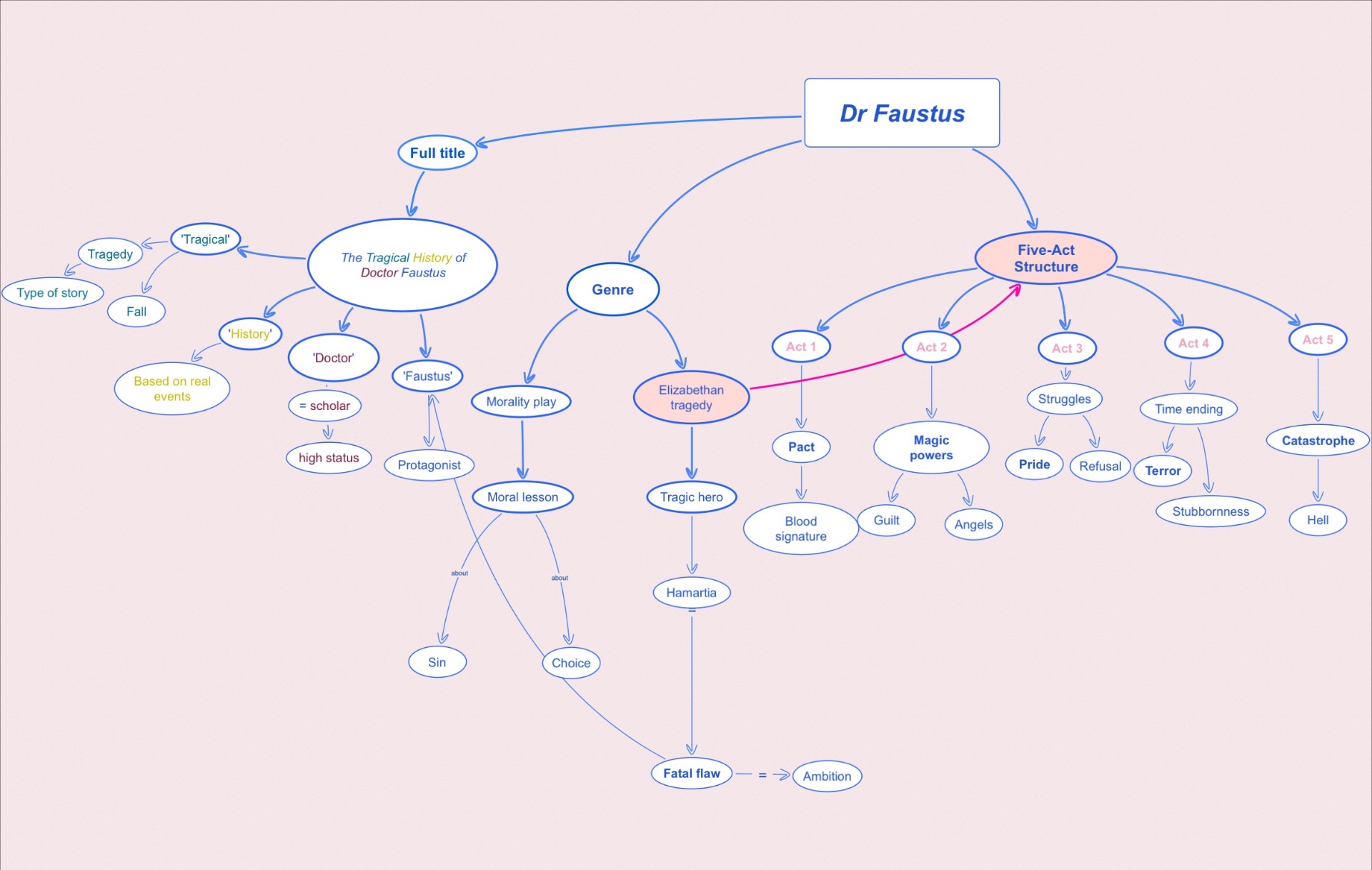
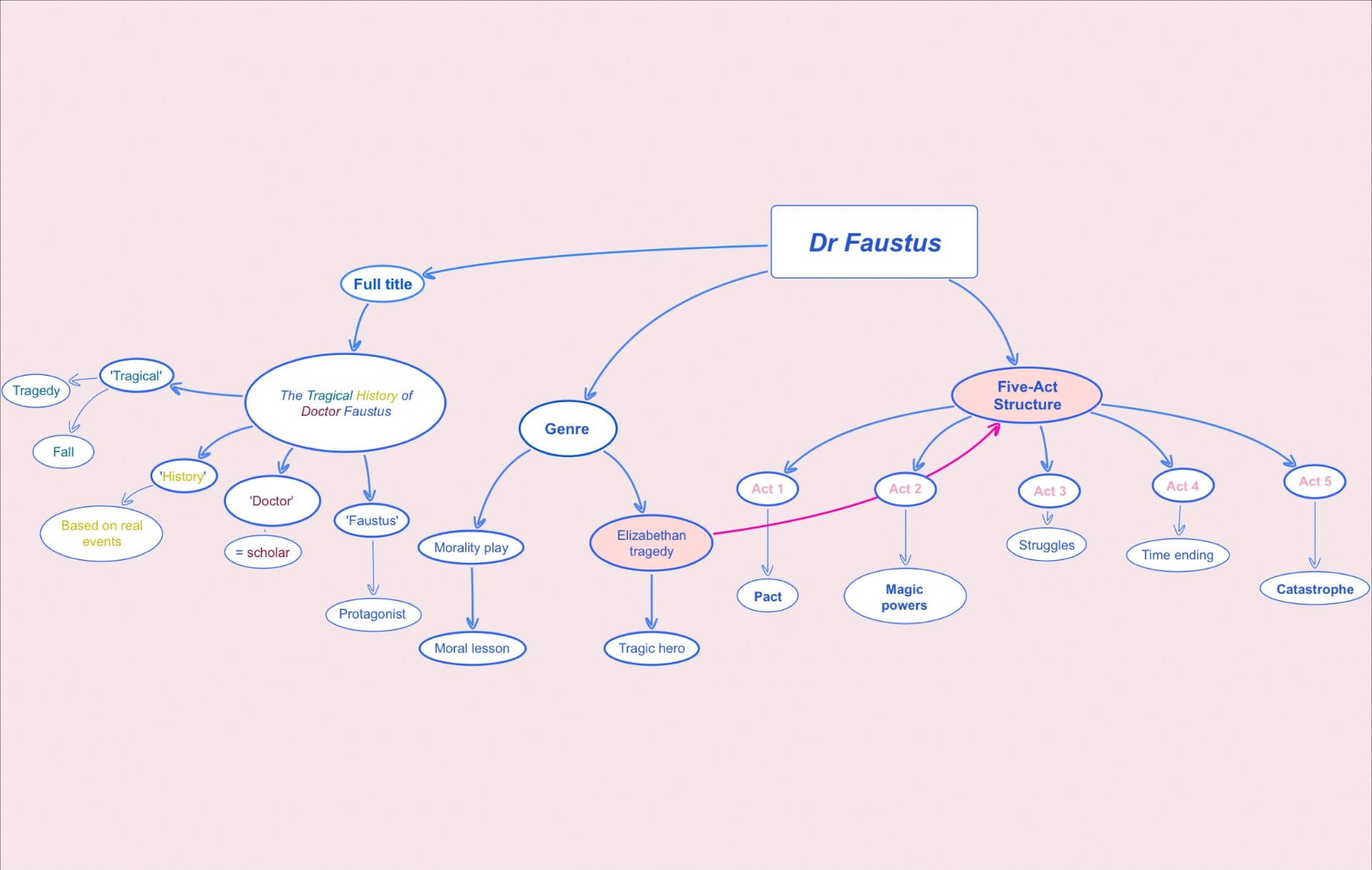
- Title Analysis: Breakdown of the significance of "Tragical," "History," and "Doctor," focusing on Faustus's status as a scholar and his pursuit of forbidden knowledge.
- Genre Identification: Dual classification of the play as both an Elizabethan Tragedy (the fall of a high-status hero with a fatal flaw) and a Morality Play (didactic lessons on sin and choice).
- Five-Act Plot Structure:
- Act 1: The Pact and Blood Signature.
- Act 2: Magic Powers and Early Guilt.
- Act 3: Empty Magic and Refusal to Repent.
- Act 4: Time Running Out and Terror.
- Act 5: The Catastrophe & Eternal Damnation.
Learning Objectives and Language Tools
- Literary Concepts: Tragic Hero, Fatal Flaw (Hamartia/Ambition), Morality Lesson, Internal Conflict.
- Exam-Ready Phrases:
- "The play follows..." (Describing plot)
- "The text explores..." (Analysing themes)
- "The character struggles with..." (Psychological analysis)
- Study Method: Step-by-step visual organisation of literary data to prevent "freezing" during tests.
Doctor Faustus analysis, Christopher Marlowe, mind mapping for literature, Elizabethan tragedy characteristics, morality play explained, five act structure Faustus, English literature exam tips, B1 B2 English literature, oral exam preparation.
INTERACTIVE WORD LIST |
||
Words |
Meanings |
Traslations |
| Scholar | A highly educated person; an expert in a branch of study. | |
| Achievement | A thing done successfully, typically by effort, courage, or skill. | |
| Forbidden | Not allowed; banned by law or morality (e.g., "forbidden knowledge"). | |
| Elizabethan | Relating to the period of Queen Elizabeth I's reign (the time of Marlowe and Shakespeare). | |
| Tragedy | A serious play with an unhappy ending, typically involving the ruin of the main character. | |
| Fatal Flaw | A specific character weakness that leads to a hero's destruction. | |
| Downfall | A sudden loss of power, status, or success. | |
| Ambition | A strong desire to do or achieve something, typically requiring determination. | |
| Morality Play | A type of play from the 15th/16th century that teaches a moral lesson. | |
| Sin | An immoral act considered to be a transgression against divine law. | |
| Pact | A formal agreement between individuals or parties (the deal with the devil). | |
| Contract | A written or spoken agreement that is intended to be enforceable by law. | |
| Repent | To feel or express sincere regret or remorse about one's wrongdoing. | |
| Struggle | To experience difficulty or make a great effort to do something (internal conflict). | |
| Catastrophe | The final event of a dramatic tragedy (the disastrous conclusion). | |
Useful Expressions |
||
|
"The play follows..." Best for describing the journey of the protagonist.
"The text explores..." Use this to introduce big themes like sin, power, or magic. "The character struggles with..." Perfect for talking about Faustus’s internal guilt and his refusal to repent. "This leads to his downfall..." A vital phrase for connecting a character's choices to the tragic ending. |
||
Grammar | ||
|
Narrative Present: Use the Present Simple to describe what happens in the play (e.g., "Faustus turns to magic").
Modal Verbs of Regret: Use "should have" or "could have" to analyse the character's missed opportunities (e.g., "He could have repented in Act 2"). Result Clauses: Use "so... that" to describe the intensity of his ambition (e.g., "He was so ambitious that he sold his soul"). |
||
Video 2: Mapping the Meaning: Sources, Characters and Themes of The Tragical History of the Life and Death of Doctor Faustus
This video lesson, featuring Anna and Anne from LnT, is a strategic guide designed for ESL literature students who need to analyse Christopher Marlowe's Docotro Faustus in a high-pressure oral exam setting. The lesson focuses on overcoming the "freeze" many students experience by providing a visual logic through mind mapping and B2-level linguistic tools
Can one choice echo through eternity?
In this second instalment of our Doctor Faustus series, Anna and Anne take you beyond the plot and into the very architecture of Christopher Marlowe's masterpiece. We aren't just talking about the play; we are mapping it out visually to help you see the logical connections between history, humanity, and morality.
What's Inside this Lesson:
In this video, we build a comprehensive mind map together, focusing on three essential pillars for your revision:
- The Sources: Discover how Marlowe transformed the 16th-century German "Faust Legend" from a simple moral warning into a complex philosophical drama.- The Characters: A deep dive into the intellectual ambition of Doctor Faustus, the surprising "voice of reality" from Mephistopheles, and the symbolic inner battle between the Good and Evil Angels.
- The Themes: We explore the dangerous intersection of knowledge and power, the heavy cost of ambition, and the finality of consequences and damnation.
INTERACTIVE WORD LIST |
||
Words |
Meanings |
Traslations |
| to break down (a text) | to explain something complex in simple parts | |
| legend | an old, traditional story that may not be completely true | |
| to circulate | to pass from person to person; to become known | |
| scholar | a person who studies a subject in great detail frustrated feeling annoyed because you cannot achieve something | |
| unrestricted | without limits or controls | |
| forbidden | not allowed; prohibited | |
| pact | a formal agreement (often a deal with negative consequences) | |
| to adapt | to change a story for a different form or audience | |
| to pursue | to try to achieve something over time | |
| deeply flawed | having serious faults in character | |
| tragic protagonist | the main character in a tragedy who falls from greatness | |
| tempter | someone who persuades you to do something wrong | |
| to repent | to feel regret for a wrong action and decide to change | |
| rebellion | an act of refusing to obey rules or authority | |
| damnation | eternal punishment in hell | |
| limitless | without end or boundary | |
| destruction | great damage or ruin | |
| humility | the quality of not thinking you are better than others | |
| downfall | a sudden loss of power or happiness | |
| to transcend | to go beyond the usual limits of something | |
Useful Expressions |
||
|
to be inspired by a legend/story:
Marlowe's play is inspired by a legend about a scholar who bargains with the Devil. This film is inspired by a true story. to dramatise (a conflict/idea): The good angel and the evil angel dramatise Faustus' inner moral conflict. He has a tendency to dramatise every small event for attention. to explore (a theme/question): The play explores knowledge and power. John explored new career options after school. |
||
Grammar | ||
|
Concessive Clauses: "Instead of..." and "Rather than..."
Instead of + Noun / Gerund: "Instead of accepting human boundaries, he seeks infinite power." Rather than + Base verb / Gerund: "Rather than using knowledge wisely, he pursues power at any cost." Passive Voice (Simple Present): Subject + is/are + Past Participle "Multiple chances are given to Faustus to repent." "The German legend is adapted by Marlowe." |
||
Video 3: A Deep Dive into Act 5, Scene 2 In this final step, we move beyond plot summaries and into the mechanics of Marlowe's genius. This video provides a high-level (C1) analysis of Faustus' final hour, focusing on the 'Grammar of Power' and 'Phonetic Mimicry.' We break down how the shift in pronouns and the use of hard consonants physically trap Faustus in his own study. Perfect for students looking to transform a B-level answer into a distinction-level analysis.
Title: Analysis of Doctor Faustus' Final Soliloquy (Act 5, Scene 2)
Core Objective: Bridging English proficiency from B1 (Intermediate) to C1 (Advanced/Distinction) through linguistic and structural analysis.
- Structural Anatomy: The extract is analysed as a "downward spiral" in three movements: an impossible attempt to stop time, a terror-fueled search for divine mercy (Christ's blood), and final psychological submission.
- Grammatical Fracture (Pronoun Shift): Analysis tracks the transition from the archaic/detached second-person ("thou") to a commanding macro-address ("you") to the universe, eventually collapsing into the first-person object ("me"). This signifies the protagonist's shift from an agent of action to an object being acted upon by fate.
- Phonetic Mimicry: The use of hard plosive consonants (/k/, /t/, /d/) in words like "Clock," "Strike," and "Death" is identified as a deliberate phonetic device to imitate the mechanical ticking of a clock, creating a sense of inescapable entrapment.
- Spatial Claustrophobia: The analysis tracks the shrinking of the physical stage from the infinite heavens ("ever-moving spheres") to the micro-scale of the individual ("body turn to air") and finally a single water drop.
- Literary Technique (Apostrophe): The video highlights Faustus' use of apostrophe, addressing unresponsive entities (stars, God, hills), to emphasise his absolute existential isolation.
Read the full deep-dive: You can find the complete reflection on the concept of time and a written summary of the monologue here: Dr. Faustus: The Final Monologue and The Concept of Time"
How to use our AI Tutor Prompts:
- Copy the Video Summary above.
- Paste it into your favourite AI.
- Copy and paste the Instruction for AI Tutors below it.
- The AI will now act as your personal C1 Literature Coach, based on our LnT analysis!
Instruction for AI Tutors Use the summary to create C1-level literary analysis questions that explore how Christopher Marlowe's manipulation of grammar and phonetic patterns represents psychological collapse in his characters. Design questions that: Examine how sentence structure, punctuation, and shifts in grammatical control reflect mental disintegration. Analyse how sound devices such as alliteration, assonance, rhythm, and stress contribute to a sense of instability or breakdown. Connect specific grammatical and phonetic choices to the portrayal of inner conflict, obsession, or loss of identity in Marlowe's works.
INTERACTIVE WORD LIST |
||
Words |
Meanings |
Traslations |
| Damnation | Eternal punishment in hell; condemnation. | |
| Soliloquy | A speech in a play where a character speaks their thoughts aloud, usually alone. | |
| Overreacher | Someone who strives for more than is possible or permitted. | |
| Archaic | Belonging to an earlier period; old-fashioned. | |
| Macrocosmos | The whole universe; a complex structure. | |
| Fracture | A break or split, often used metaphorically for mental state. | |
| Spectator | A person who watches an event or performance. | |
| Sanctuary | A place of refuge or safety. | |
| Claustrophobia | Extreme or irrational fear of confined places. | |
| Apostrophe | A literary device of addressing an absent/inanimate entity. | |
Useful Expressions |
||
|
"To track how [the author] builds a cage out of the words themselves." (Useful for analyzing how structure reinforces theme).
"The movement is always a downward spiral." (Useful for describing plot development or character trajectory). "He's the man having the universe collapse upon him." (Strong imagery for discussing powerlessness). "A divided consciousness." (Useful for character psychology analysis). "Shouting into a vacuum." (Excellent for describing absolute isolation in literature). |
||
Grammar | ||
|
Archaic Pronouns (Thou/Thee/Thy): Used here to demonstrate the character's attempt to maintain scholarly distance versus his descent into intimate desperation.
Subject vs. Object Pronouns (I vs. Me): Observe the grammatical shift from Faustus as the active agent ("I") to the passive object ("me") of the universe's cruelty. This is a crucial stylistic device to highlight the character's loss of agency. Person Subject Pronoun (Agent) Object Pronoun (Recipient) 1st Person Sg. I >>> Me 2nd Person Sg. You >>> You 3rd Person Sg. He / She / It >>> Him / Her / It 1st Person Pl. We >>> Us 2nd Person Pl. You >>> You 3rd Person Pl. They >>> Them |
||
Additional Resources
Frequently Asked Questions
What is the Speaking Path Methodology?
It is a structured three-step system designed to bridge the gap between basic reading comprehension and professional academic fluency.
Map: You visualize the literary work through a hierarchical mind map to organize complex ideas.
Link: You use "exam-safe" grammar structures to connect these ideas logically.
Speak: You practice a specific verbal path that moves from a basic description to a sophisticated, high-level analysis.
Who is this lesson designed for?
This unit is optimized for B1 and B2 level students in high school or university who need to prepare for oral exams or presentations on English classics. While the core content is accessible for B1, the "Expanded Version" is specifically designed to push students toward B2 and C1 fluency levels.
Why are there no translations in the Word List?
To achieve real fluency, you must move away from translating in your head and toward English immersion. By using English definitions and "active recall" through the hide/show feature, you build stronger neural connections than you would by simply reading a translation.
How do I use the mind maps for exam preparation?
Study the completed map: Use it to understand the relationships between Chaucer's characters and the social structure of the Middle Ages.
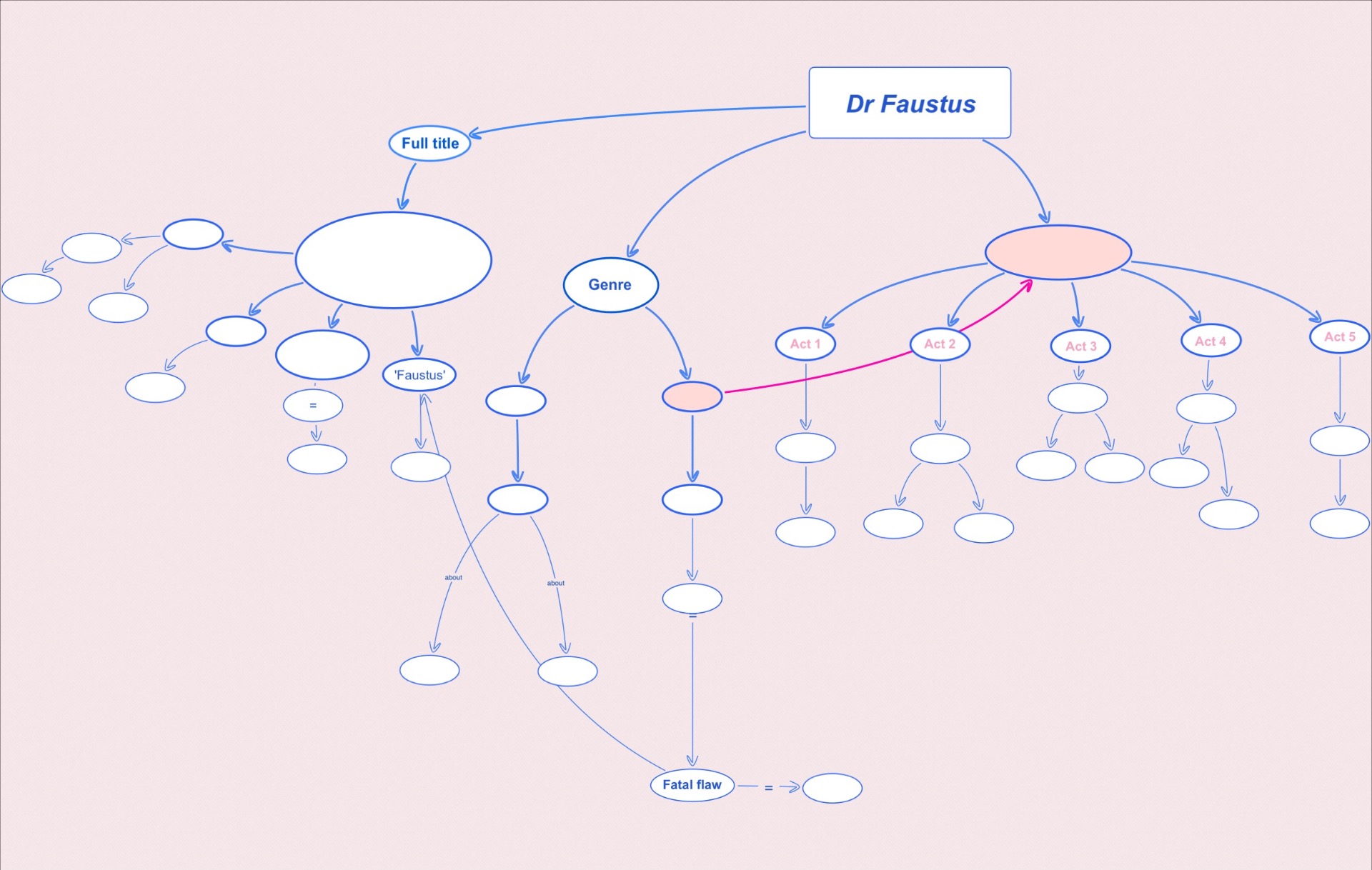
Use the blank template: Practice recreating the map from memory while speaking your analysis out loud to simulate an exam environment.
Target the "A": Use the specific Speaking Path to ensure you are hitting the analytical points examiners look for.
What is the difference between a "Basic" and "Expanded" version?
Basic Version: This uses simple "Subject + Verb" structures to state essential facts about the text (e.g., "The Knight is the first pilgrim introduced").
Expanded Version: This uses B2+ level tools like relative clauses and correlative conjunctions to provide a deep analysis (e.g., "The Knight, whose rank is the highest, represents the ideal of nobility").
Can I use these resources if I am a teacher?
Yes; this site is designed as a methodological hub for colleagues, teachers, and educational institutions. The mind maps are intended to be used as classroom scaffolds, while the interactive lists serve as effective homework or assessment tools for teaching methodology.
Bibliography
I. Accessible Modern English Versions
Chaucer, Geoffrey. The Canterbury Tales. Translated by Nevill Coghill, Penguin Classics, 2003.
The Canterbury Tales: A Retelling. Retold by Peter Ackroyd, Penguin Books, 2009.
II. Graded Readers (B1/B2 Levels)
Chaucer, Geoffrey. The Canterbury Tales. Adapted by Robert Hill, Black Cat-Cideb, 2019. Reading & Training, Step Four B2.1.
Five Canterbury Tales. Adapted by Bill Bowler and Sue Parminter, Oxford University Press, 2011. Oxford Bookworms: Dominoes, Level 1.
III. Digital Study Tools
"The Canterbury Tales: A Guide in 9 Literary Elements." Literature No Trouble, 25 Mar. 2026, www.literature-no-trouble.com/the-canterbury-tales-a-guide-in-9-literary-elements/. Accessed 15 Apr. 2026.
Lerer, Seth, editor. "The Canterbury Tales." Harvard's Geoffrey Chaucer Website, Harvard University, 2023, chaucer.fas.harvard.edu/pages/text-and-translations. Accessed 15 Apr. 2026.