
Paradise Lost
Study Hub
STEP 1 - WATCH
STEP 2 - BUILD VOCABULARY
STEP 3 - STUDY THE MAPS
STEP 4 - SPEAK
Video 1: Mapping the Structure and Plot of Paradise Lost
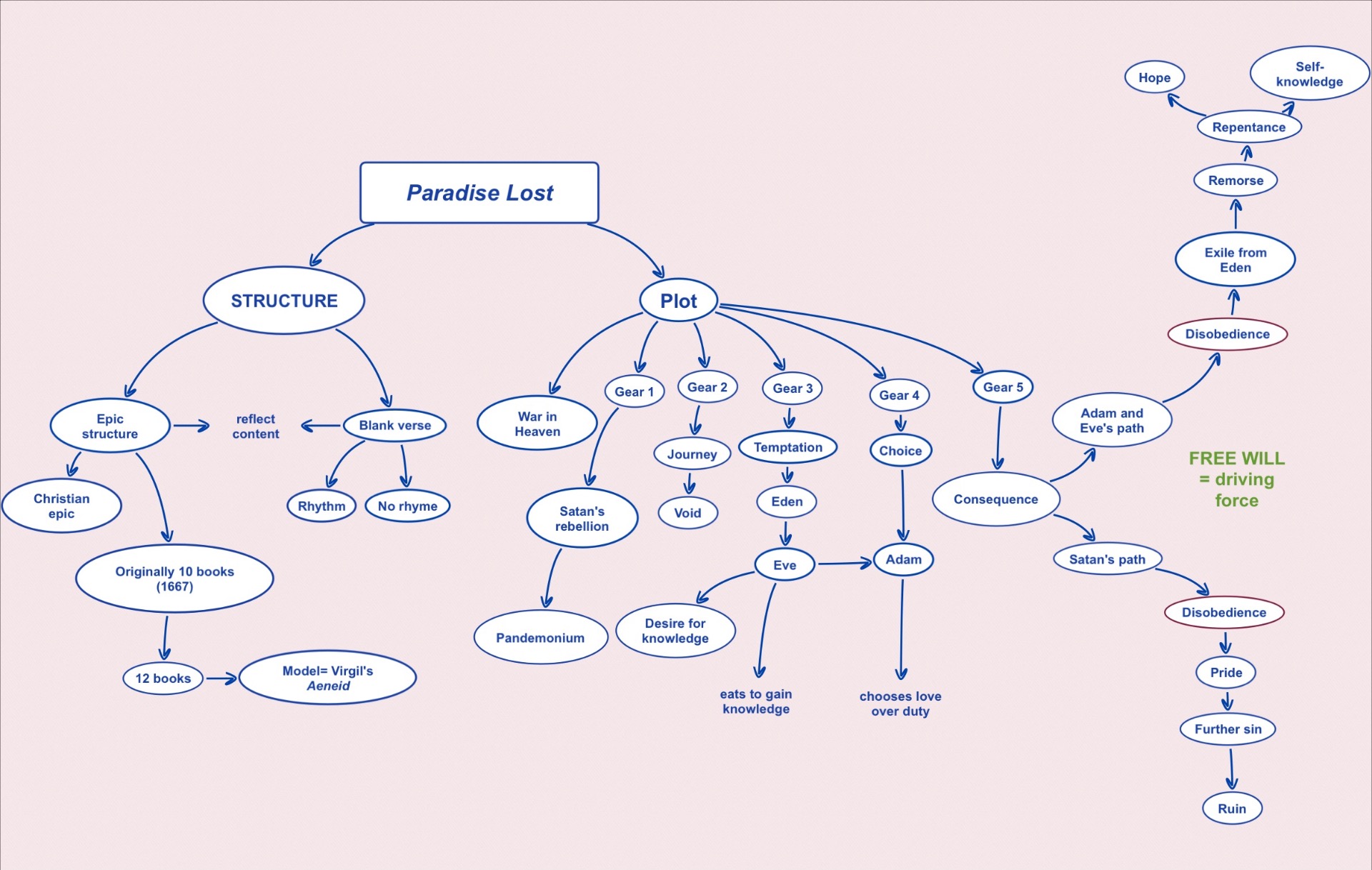
This first video in a five-part series offers a clear, visual roadmap to John Milton's Paradise Lost, designed to support preparation for an oral exam. Anna and Anne create a comprehensive map of the poem's plot and structure, helping students see how the epic unfolds and how its major episodes connect. Along the way, the video highlights essential literary terms and concepts that are frequently discussed in exams, making it a practical starting point before exploring the next parts of the series.
For a close reading, see Satan's Speech Analysis.
INTERACTIVE WORD LIST |
||
Words |
Meanings |
Traslations |
| to dictate | to speak words aloud for someone else to write down | |
| in medias res (lit. term) | Latin: starting a story in the middle of the action, not at the beginning in medias res | |
| rebellion | an organised refusal to obey authority or rules | |
| pandemonium | wild chaos and noisy disorder; in the poem, Satan's palace in hell | |
| to corrupt | to cause someone to become immoral or dishonest | |
| temptation | a strong desire to do something, especially something wrong or forbidden | |
| consequence | a result or effect of an action or event | |
| to repent | to feel deep regret for a wrongdoing and decide to change | |
| redemption | the act of being saved from sin, wrongdoing, or a bad situation | |
| disobedience | refusal or failure to follow rules or commands | |
| exile | the state of being forced to leave one's home or country | |
| blank verse (lit. term) | poetry with a regular rhythm but no end rhyme | |
| iambic pentameter (lit. term) | a rhythmic pattern of 10 syllables per line, alternating unstressed and stressed | |
| epic form (lit. term) | the structure of a long narrative poem following classical tradition (Homer, Virgil) | |
| free will | the ability to choose one's own actions independently, without being forced | |
Useful Expressions |
||
|
PHRASE
unfolds like LIT. EXAMPLE "The tragedy unfolds like a chain reaction." EVERYDAY EXAMPLE "The story unfolds like a detective novel." PHRASE is organised into LIT. EXAMPLE "The poem is organised into 12 books." EVERYDAY EXAMPLE "My study plan is organised into three parts." PHRASE the power of LIT. EXAMPLE "The power of the mighty line comes from its uninterrupted flow." EVERYDAY EXAMPLE "You can feel the power of the engine in this car." |
||
Grammar | ||
|
1. The Passive Voice:
The passive voice is a hallmark of analytical writing. It allows the writer to focus on the text, the structure, or the methodology rather than the person who performed the action. The Formula: Subject+verb to be (conjugated)+Past Participle Present Simple: "The poem is organised into 12 books". Past Simple: "The story of free will was written in blank verse". Why use it? When analyzing literature, you want to sound objective. By using the passive, you shift the focus from the author to the work itself, which is a required skill for advanced learners. 2. The Imperative Mood: Defining Methodology The imperative is the most effective way to provide clear, actionable instructions. It is direct and essential for explaining your study methods or guiding a peer through your analysis. The Formula: Base Form of the Verb(+the rest of the sentence) Positive Instruction: "Write the title on top of the page". Positive Instruction: "Draw two arrows out of that last gear". Negative Instruction: "Don't use a pen". Why use it? In an oral exam, you may need to explain your "map" or "methodology." Using the imperative allows you to lead the examiner through your thought process clearly and confidently. |
||
Video 2:
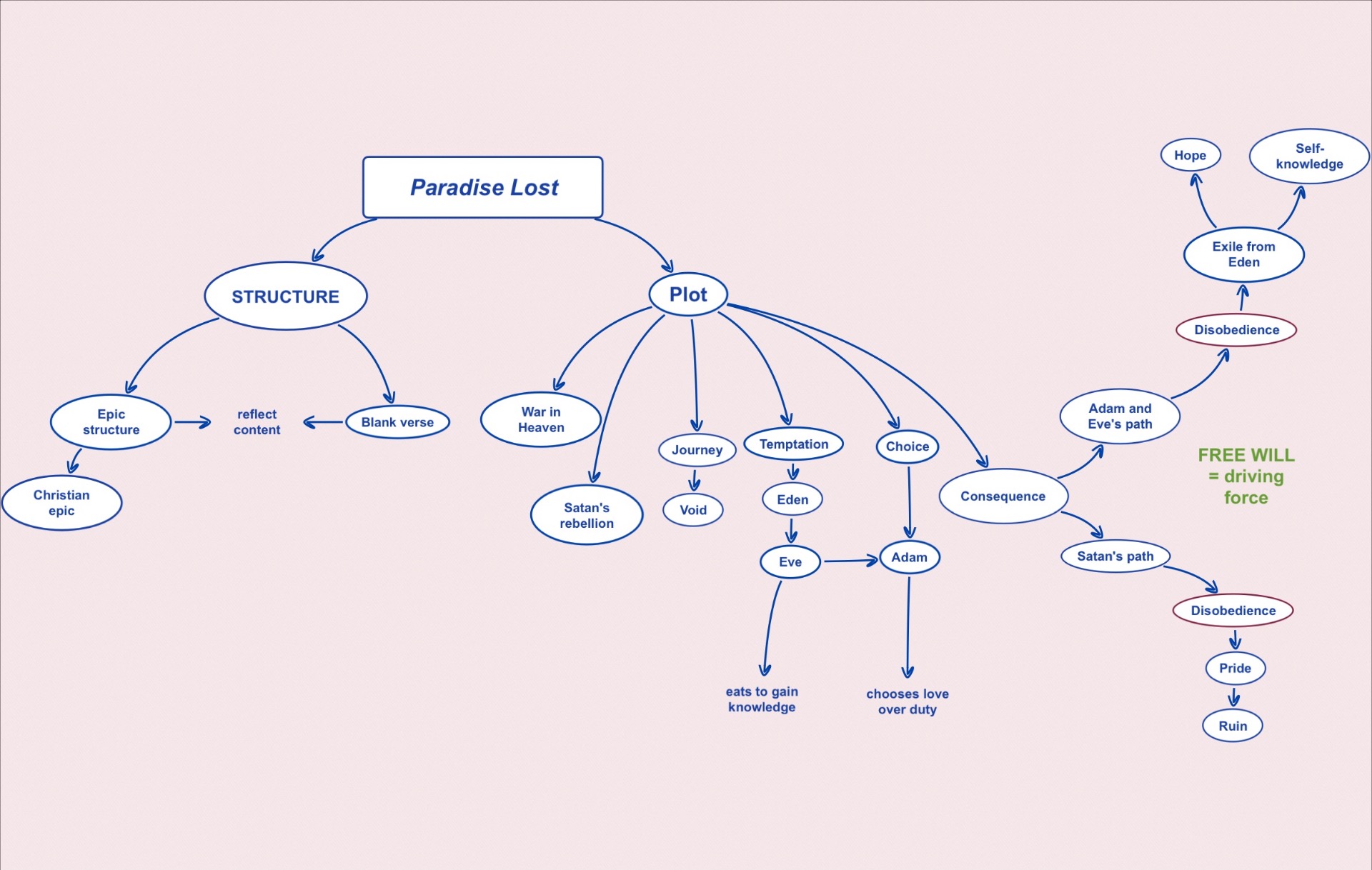
This second video in our five-part series delves into the core foundations of John Milton's Paradise Lost, providing students with the essential tools to discuss the poem's opening and its protagonists. Anna and Anne expand the analytical map to explore the significance of the title, the context and the characters.
The lesson provides a clear breakdown of the poem's complex characters, examining the roles of God, the Son, and the rebellious nature of Satan, alongside the introduction of Adam and Eve. By connecting these figures to the overarching context of the epic, this video helps students build the specific vocabulary and conceptual clarity needed to excel in B1/B2 level oral tests/exams.
INTERACTIVE WORD LIST |
||
Words |
Meanings |
Traslations |
| Enclosure | A space that is closed in or surrounded by boundaries. | |
| Consequence | The result or effect of an action. | |
| Allegory | A story or text that has a hidden meaning (political or moral). | |
| Antihero | A protagonist who lacks typical, perfect heroic qualities. | |
| Archetype | The original model or a perfect example of a person/thing. | |
| Redemption | Being saved or forgiven for past mistakes or sins. | |
| Harmonious | Existing in a state of balance, agreement, and peace. | |
| Theological | Relating to the study of God, religion, and divine principles. | |
| Expulsion | The act of forcing someone to leave a place. | |
| Justify | To show or prove that a decision or action is fair or right. | |
| Charismatic | Having a strong personality that attracts or influences others. | |
| Repentance | Feeling and expressing sincere regret for one's wrongdoing. | |
| Subversion | The act of undermining an established system or authority. | |
Useful Expressions |
||
|
Useful phrase: Represents the idea of
Literature Example: "In Paradise Lost, the Garden of Eden represents the idea of a perfect harmony." Everyday English Example: "For my grandparents, their old house represents the idea of a world that no longer exists." Useful phrase: Serves as a reminder that Literature Example: "The fall of Adam and Eve serves as a reminder that human choices carry permanent consequences." Everyday English Example: "My first failed exam serves as a reminder that starting early matters more than working hard at the last minute." Useful phrase: Explores the theme of Literature Example: "Paradise Lost explores the theme of the fortunate fall, the idea that humanity can reach a higher state after the loss." Everyday English Example: "This video explores the theme of how to speak confidently when you're still learning." Useful phrase: Is inspired by Literature Example: "Milton's style is inspired by Homer and Virgil, but he tells a specifically Christian story." Everyday English Example: "My approach to studying is inspired by the memory techniques I learned from this channel." Useful phrase: Reflects the tension between Literature Example: "Satan reflects the tension between his leadership skills and his inability to use them for good." Everyday English Example: "An Instagram profile reflects the tension between the perfect aesthetic life and the real mess of an exam week." Useful phrase: Despite... ultimately... Literature Example: "Despite the catastrophe, Eve ultimately demonstrates the power of human recovery." Everyday English Example: "Despite starting with no map, I ultimately found my way using this method." |
||
Grammar | ||
|
Participle Clauses (Adding Detail Without Complexity)
What they are: These are "shortened" ways of adding extra information about a character or author without starting a whole new, clunky sentence. The Script Example: "Written when Milton was blind, politically ruined, and still somehow producing one of the greatest poems..." Why use them: In an oral exam, students often make errors by overusing "and" or repeating the subject (e.g., "Milton was blind. He was also ruined."). By using a participle clause, you combine these facts into one smooth, professional sentence. Simple Rule: Use the -ed form (past participle) to describe a state (e.g., “Politically ruined, Milton…â€) or the -ing form to describe an action (e.g., “Thinking deeply, Milton wrote…â€). It makes you sound like a native speaker! Contrastive Connectors (Building a Sophisticated Argument) What they are: Words used to show two opposing sides of a story or character. The Script Example: "Despite her choice of being the cause of the fall, she ultimately proves that repentance leads to redemption." Why use them: Examiners love when students show "critical thinking." Instead of just listing facts, you show that you understand conflict. Using "Despite" or "While" proves you are looking at the complexity of the text. Simple Rule: Despite + -ing: Use this when you want to show that something happened even though something else was true. (e.g., "Despite being a villain, Satan shows human-like pride.") Ultimately: Use this word to signal the "big conclusion" of your point. It is a powerful word to use right before you finish your analysis of a character. Pro Tip 80% of your grade comes from your ability to link different parts of your map. Don't memorise long paragraphs. Memorise these two grammar structures, and you will be able to link any topic, whether it’s history, philosophy, or literature, with ease. |
||
Video 3:
INTERACTIVE WORD LIST |
||
Words |
Meanings |
Traslations |
| Seating | The arrangement of where people sit, often revealing their social importance. | |
| Talu | A Middle English word that means both a "story" and a "score" or "tally." | |
| Competition | A contest where people try to win a prize or be the best at a task. | |
| Destination | The final place someone is traveling to (in this case, Canterbury). | |
| Pilgrimage | A religious journey made to a sacred or holy place. | |
| Estates | The different social classes in medieval society (Nobility, Clergy, Commoners). | |
| Martyrdom | The death of a person who is killed because of their religious beliefs. | |
| Manuscript | A book or document that was written by hand before printing existed. | |
| Cross-section | A small group that represents all the different types of people in a society. | |
| Framework | The basic structure that supports a larger system or story. | |
Useful Expressions |
||
|
"Carry both meanings at once"
Example: The title 'The Canterbury Tales' carries both meanings at once: a story and a competition score. "Lined up in order of importance" Example: Chaucer lined up the pilgrims in order of importance, starting with the Knight. "A structural device in which..." Example: A frame narrative is a structural device in which one overarching story contains many smaller ones. |
||
Grammar | ||
|
Relative Clauses (B2 Sophistication)
To move from B1 to B2, use "whose" to link a character to their status. Example: "The Knight, whose rank is the highest, represents the ideal of nobility." Correlative Conjunctions (Analytical Depth) Use "Both... And" to explain complex literary characters. Example: "Chaucer’s characters are both social archetypes and individual human beings." |
||
Additional Resources
Frequently Asked Questions
What is the Speaking Path Methodology?
It is a structured three-step system designed to bridge the gap between basic reading comprehension and professional academic fluency.
Map: You visualize the literary work through a hierarchical mind map to organize complex ideas.
Link: You use "exam-safe" grammar structures to connect these ideas logically.
Speak: You practice a specific verbal path that moves from a basic description to a sophisticated, high-level analysis.
Who is this lesson designed for?
This unit is optimized for B1 and B2 level students in high school or university who need to prepare for oral exams or presentations on English classics. While the core content is accessible for B1, the "Expanded Version" is specifically designed to push students toward B2 and C1 fluency levels.
Why are there no translations in the Word List?
To achieve real fluency, you must move away from translating in your head and toward English immersion. By using English definitions and "active recall" through the hide/show feature, you build stronger neural connections than you would by simply reading a translation.
How do I use the mind maps for exam preparation?
Study the completed map: Use it to understand the relationships between Chaucer's characters and the social structure of the Middle Ages.
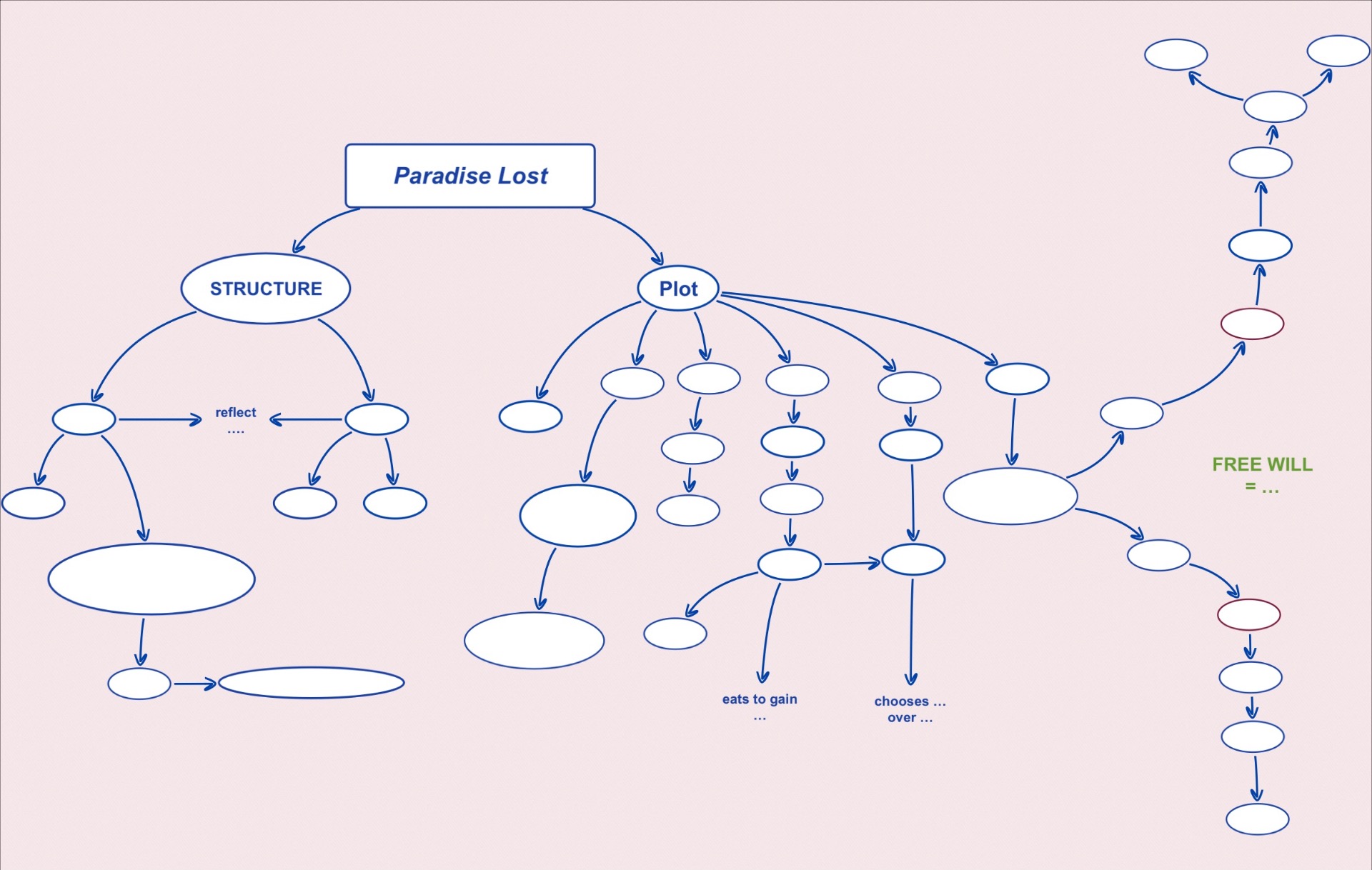
Use the blank template: Practice recreating the map from memory while speaking your analysis out loud to simulate an exam environment.
Target the "A": Use the specific Speaking Path to ensure you are hitting the analytical points examiners look for. You can also practise with Satan's Speech Analysis for focusing on your speaking skill.
What is the difference between a "Basic" and "Expanded" version?
Basic Version: This uses simple "Subject + Verb" structures to state essential facts about the text (e.g., "The Knight is the first pilgrim introduced").
Expanded Version: This uses B2+ level tools like relative clauses and correlative conjunctions to provide a deep analysis (e.g., "The Knight, whose rank is the highest, represents the ideal of nobility").
Can I use these resources if I am a teacher?
Yes; this site is designed as a methodological hub for colleagues, teachers, and educational institutions. The mind maps are intended to be used as classroom scaffolds, while the interactive lists serve as effective homework or assessment tools for teaching methodology.
Bibliography
Frye, Northrop. The Return of Eden: Five Essays on Milton's Epics. University of Toronto Press, 1965.
Fish, Stanley. Surprised by Sin: The Reader in Paradise Lost. 2nd ed., Harvard University Press, 1998.
Halli, Robert. "Proportion Due Giv'n and Receiv'd: Tailoring Paradise Lost to the Survey Course." Approaches to Teaching Milton's Paradise Lost, Modern Language Association, cited in teaching discussions of the poem.
Lewis, C. S. A Preface to Paradise Lost. Oxford University Press, 1942.
Milton, John. Paradise Lost. Edited by Gordon Teskey, W. W. Norton, 2005.
Milton, John. Paradise Lost. 1667 ed.
Milton, John. Paradise Lost. 1674 ed.
Poetry Foundation. "Advice for Teachers." Poetry Foundation, Poetry Foundation, 2024.
Teskey, Gordon, editor. Paradise Lost. W. W. Norton, 2005.